Monday, March 11, 2013

Would Jesus have a Twitter account?

I picked up on this blog post by Natalia Angulo, who poses the question: "Is Jesus Social Media Savvy". Particularly relevant to what we are trying to do here, i.e. the gradual introduction of social media (e.g. this blogging platform) to our congregation at St Michael's Church, and the wider community through our Outreach work. I recommend reading the full post by Natalia, but I felt these abstracts were particularly relevant:
Celebrities may have more followers, but with 1.3 billion impressions every 30 days and over 16.5 million fans, Jesus Daily claims to be the most engaged Facebook page in the world. The site’s success is indicative of the way religion has moved beyond the churches and synagogues onto the web, where faith can touch us not just on the weekend but every day. ....
......Even Emeritus Pope Benedict XVI took to Twitter at age 85, quickly building up more than 1.6 million followers before signing off the social network on Feb. 28 following his almost unprecedented resignation, sending a final thankful tweet:
@Pontifex: “May you always experience the joy that comes from putting Christ at the centre of your lives.” .....
.....Another religious leader with a large following on Twitter is the Dalai Lama who on his @DalaiLama verified account has more than 6 million followers.

....Just as St. Paul was willing to travel in order to spread the message of the gospel, Morris -- who uses Twitter and Facebook, and hosts a SirusXM Catholic radio channel -- sees social media not just as an opportunity, but an obligation to reach out to people who may not be coming into his pews on Sundays, as well as a means to keep in touch with parishioners.....
It seems that social media has come too late for many people at St Michael's, i.e. there is precious little engagement on this blog, and Twitter remains an enigma for the vast majority. I think that social media is viewed as a young person's environment, to be avoided at all costs by the 'older demographic', which is clearly not the case if you look at the examples of Pope Benedict and the Dalai Lama mentioned above - neither of whom are enjoying the springs of youth!

So, does social media have a role to fulfil in reaching out to the people in our Parish (and beyond), who are unlikely to ever set foot in any church, let alone St Michael's? Surely it does, and if Jesus was living amongst us - physically - today, I'm sure he would have a Twitter account!

Friday, February 15, 2013

Micah Challenge International

I thought it might be worthwhile posting details of the new "Micah Challenge International", which is aimed at corruption in politics. The campaign was prompted by the arrest of retired Anglican Bishop Zac Niringiye, who was detained whilst campaigning against corrupt practices by politician in Kampala. The following abstract is from the Micah Challenge website:

This Thursday 14 February Rev David Zac Niringiye will report to Wandegeya Police Station in Kampala and there is a chance that he could be taken to court and charged with the crime of ‘inciting violence’ and asked to report again.  But he is also hoping that the case will be dismissed on the advice of the Director of Public Prosecution.
Last Monday, Anglican bishop, Niringiye, was arrested and detained in Kampala for distributing materials denouncing corruption, to students at Makerere University in Kampala.
His action was part of Black Monday, a movement of many different groups raising awareness and demanding action against the theft of public resources by politicians and public servants.  Bishop Niringiye has written that, “Corruption is stealing right out of the pockets of ordinary Ugandans. People are dying because they cannot access basic health care from trained staff.
Micah Challenge is preparing to launch a global call with 1 million signatures against corruption with EXPOSED 2013, which is call to action for Christians around the world to shed light on the corruption which robs the world's poorest.

Wednesday, September 19, 2012

Catholic charity seeks to block same-sex couples from its adoption service


There was a news report in the paper earlier this week about a Catholic adoption agency that was seeking to deny its services to same-sex couples. Catholic Care is asking the judge, sitting in the Upper Tribunal in London to sanction a change to its charitable objectives so that it can lawfully turn away same-sex couple as prospective adopters. However, lawyers for the Charity Commission argue that drawing a distinction between gay and heterosexual couple would amount to a breach of the Equality Act 2011 and a violation of the ban on discrimination contained in the European Convention on Human Rights.

Now I appreciate this a very sensitive issue, and there will no doubt be entrenched positions being taken on all sides. It's not the first time - and certainly not the last - that Christian traditions and beliefs have come into conflict with the minutiae of equality and human rights laws. According to a spokesperson from Catholic Care, the consequence of the court finding against it will be a cessation of its services to both gay and heterosexual couples. 

I want to make clear that, personally, I have no issue with the Catholic Church or it's traditions and beliefs. I am neither for or against same-sex couples adopting children; the key criteria for me is that the child's interests and welfare is put first and foremost. If the appropriate experts believe that a child would be better off in a safe and loving home than remaining indefinitely in the care of the local authority, then any consideration about same-sex or heterosexual couples becomes irrelevant.

I do feel quite strongly in this case that the Charity Commission's focus on the rights of same-sex couples, rather than the children in need of adoption, is tantamount to putting the interests of the helper before those of the helpless. 

I wonder what Jesus would think if He was here today?

Friday, August 17, 2012

Is the end of the collection plate nigh?

According to a recent report from JustGiving, which raises cash for charities online, donations to religious causes have increased by 128 per cent over the past five years. Older donors have led the trend and are choosing the email inbox over the collection box in ever larger numbers.

Direct religious donations by the over-60's outstripped those of any other age-group, nearly trebling over the period, according to the report.

Harnessing the internet to benefit from the generosity of the faithful muts now become a priority for churches if they are to survive, the report shows.

The Right Rev Stephen Lowe, retired Church of England bishop for urban life and faith was quoted as saying: "We have not got the gear to receive the donations. How much longer can we keep passing the plate when people have not got the cash?".

So, are we going to see the day when mobile phones will be permitted - nay - encouraged in church during services so that the congregation can donate by text? It's clear we are increasingly becoming a cashless society, so at the very least, churches need to start thinking of alternatives to the traditional collecting plate.

What do you think?


Wednesday, July 4, 2012

The Banking Crisis: Symptomatic Of A Decline In Moral Values?

The banking crisis seems to roll on, with new and incriminating revelations each day. Up until a week ago, most people had never heard of "LIBOR", but we now know that many banks (not just Barclays) have been manipulating the rates they charge each other for lending money in order to boost personal bonuses and bank profits. Since the LIBOR also influences mortgage rates, ordinary people may have been disadvantaged by paying more than they needed to. All of this comes on top of the mis-selling scandals, where payment protection insurance was sold to people with no chance of claiming, and business loans that severely disadvantaged small businesses.

So, banks and bankers - once held as the bastions of trust and probity - have been found with their fingers in the till, and any trust we had in them has long since evaporated.

But I wonder if this is just symptomatic of a wider problem with society, where "self" comes before "community", and where our economy is based almost entirely on consumerism. All the more worrying in that we're consuming more than we're replacing, leaving devastated fishing grounds and barren rain forests in our wake. What sort of world will our children and grand-children inherit? Can nature self-heal the scars we are creating, or are we indeed on the road to oblivion? Are we all becoming more selfish and self-serving because we see evidence of this all around us, not least bankers and politicians (remember the expenses scandal)?

Is the Church doing enough to remind us of our responsibilities to each other and God's earth? Does religion have any role at all to play in the events unfolding with the banking crisis...or whatever the next crisis involving greed and personal reward will hit the news?

Lot's of questions here I know, but surely we all have an opinion on these issues....don't we?

What do you think? 

Sunday, June 17, 2012

Redefining Marriage


There is a considerable amount of debate at present about the proposed legislation to redefine marriage, with the prospect – it seems – of a schism between Church and State if the proposed legislation becomes law.

I’m no expert on the issues being debated, and in order to aid my understanding I’ve borrowed heavily from a sermon on this topic given by Rev’d Toby Marchand back in May. From what I’ve understood so far, the re-defining of marriage is being raised in order that gay and lesbian couples might be able to marry, rather than enter in to Civil Partnerships, which is what they are allowed to do now.

The Church, in the shape of the Church of England, is against the idea, as can be seen from this official response to the consultation. The submission, sent to the Home Secretary under a short covering letter from the Archbishops of Canterbury and York (after consideration in draft by the House of Bishops and Archbishops Council) also points out:

·       Several major elements of the Government's proposals have not been thought through properly and are not legally sound. Ministerial assurances that the freedom of the Churches and other religious organisations would be safeguarded are, though genuine, of limited value given that once the law was changed the key decisions would be for the domestic and European courts. 

·       Such a change would alter the intrinsic nature of marriage as the union of a man and a woman, as enshrined in human institutions throughout history. Marriage benefits society in many ways, not only by promoting mutuality and fidelity, but also by acknowledging an underlying biological complementarity which includes, for many, the possibility of procreation. The law should not seek to define away the underlying, objective, distinctiveness of men and women. 

·       The Church has supported the removal of previous legal and material inequities between heterosexual and same-sex partnerships. To change the nature of marriage for everyone will deliver no obvious additional legal gains to those already now conferred by civil partnerships. 

Under the current legislation there are three options:

You may marry if you are a heterosexual who has never had, or are now free from, former official relationships. You may, if you wish, marry in church. We might label that “religious marriage”.

You may marry if you are a heterosexual who has never had, or are now free from, former official relationships, in a Registry Office. We might label that “Civil Marriage”. Whilst that is not overtly religious it is possible to follow it with a Blessing in church, though many choose not to do so.

 You may, if you are a homosexual, either male of female, enter in to a Civil Partnership which has to be registered. This has been possible since 2005.

Rev’d Toby Marchand’s sermon, which I referred to earlier, crystallises the issues as follows:

Reasons for accepting the change:

  1.  Same-sex marriage is indistinguishable from the marriage of two people unable to have children.
  2. We bless 2nd marriages of non-churchgoers, but reject faithful couples who long to bring their love and commitment before God.
  3. It is an extension of the sacrament of marriage comparable to the extension of the sacrament of Ordination to women.
  4. It is not physical gender that matters but quality of commitment, and response to the call of God.
  5. If marriage is a cornerstone of stable society the extension of it to gay couples will be a welcome extension and will have a stabilising effect on all around. It is the reinforcement of an ancient tradition.

Reasons for not accepting change:

  1. The institution of marriage is very ancient and has been the bedrock of societies world-wide in every conceivable culture
  2. The public don’t want change. 70% want to keep things as they are. 230,000 people have already signed a petition against it in only a few days.
  3. Marriage has never meant simply the right of all couples to have their relationship legally recognised. If you start unpicking a social convention so fundamental to our lives where do you stop? Why shouldn’t Muslims be allowed polygamous marriages?


I guess that everyone will have their own opinion on all of this, and no doubt there will be strident views from both sides of the equation. But personally, I support the official response from the Church of England, and wonder whether in fact the Government are confusing a “wedding” with a “marriage”.  

Civil Partnership is surely the best way of affirming same-sex relationships. It gives legal protection, can receive the blessing of the Church in the form of a “wedding” between the couple and it preserves traditional understanding of “marriage”.

I personally believe that “marriage” still has to be between a man and a woman if it is to be marriage, with the possibility (or not) of procreation. Such a huge change in definition and thinking that is being proposed will take a long time to be accepted and certainly shouldn’t be done at such a speed and with such little consultation or listening.

I’d be interested in anyone else’s views on this – not insignificant – debate.

Thursday, May 10, 2012

An Evening With Toby Marchand


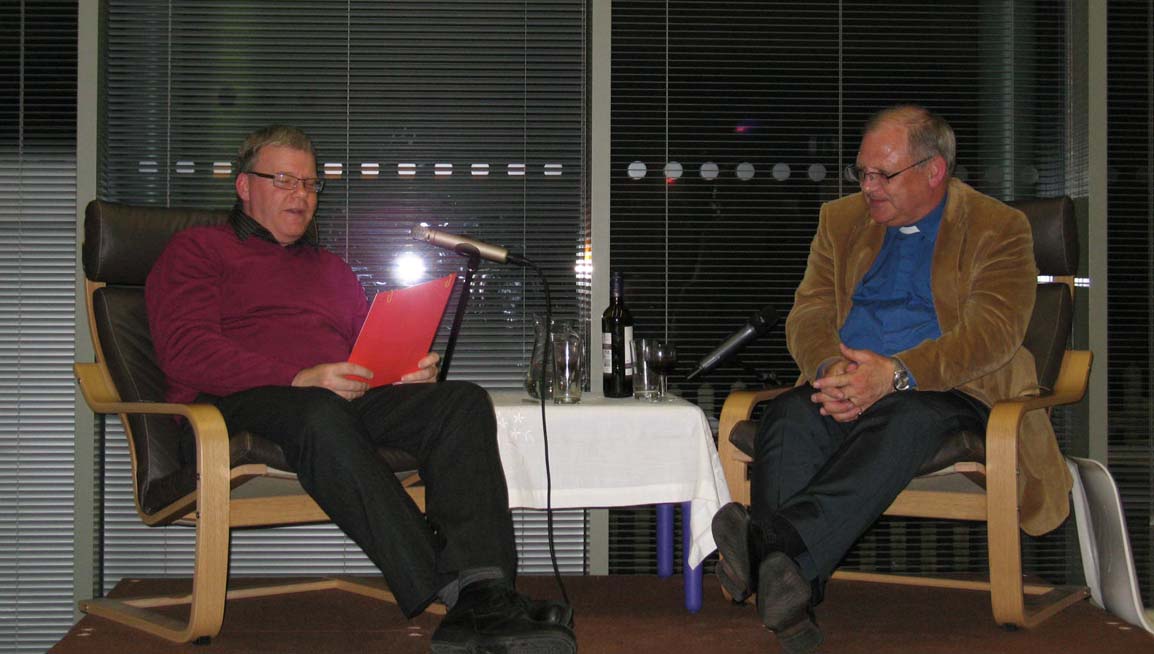
The St Michael's Men’s Group arranged "An Evening With Toby Marchand' (our vicar)  on Thursday 12th April in the Charnley Hall, following the format of that well know Radio 4 programme "Desert Island Discs".  The event was a great success, attracting an audience of 35 members from the congregation. 

Toby had chosen eight recordings of music and narrative pieces interspersed by questions put to him by Mike Ashwood. The music included:
  • a Jazz piece from Belize (where he first met Madi when they were both on VSO duties there), 
  • a cello work and other classical works (Elgar’s Nimrod’, the’ Dies Irae’ from Verdi’s Requiem and ‘Cum Sancto Spiritu’ from Rossini’s Petite Mess Solenelle). 
  • Amusing extracts from ‘Beyond the Fringe’ (Take a Pew) 
  • a speech by Martin Luther King 
  • a performance by the Monks at Chevetogne in Belgium near which Toby had spent many rewarding times at a nearby retreat. 

Toby spoke of his early life, his travels and his ministry at his various churches, and provided us with an insight into his plans for retirement (which included furthering his proficiency playing the cello).  

The book he chose was Dante’s Divine Comedy and his luxury item an everlasting supply of ice cream! 

After answering a few further questions from the audience we concluded with a ‘Ploughman’s Supper’. It turned out to be a very enjoyable evening which will provide many happy and interesting memories for all who attended.